
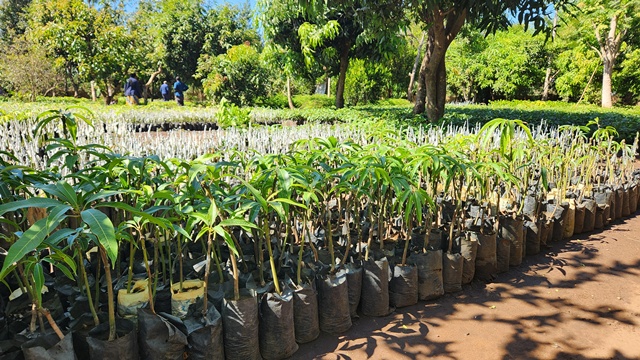
When I look across the Malawian landscape it reminds me of the savanna, and the desert. There are occasional wide, low trees. Mostly it is small trees and brown fields. How can anything grow here? In June the water is all sitting below the ground, but in October the rains will come and soak everything; almost every day. There is no shortage of water… just a shortage of plants.

They need tending during the dry season to stay alive, but water is easily accessible with the wells in each village. Paul said he wished he would of thought of planting trees when he first started going to Malawi 20 years ago. If he did there would be so much shade and fruit. It’s still better to do later than never. Last year and this year we bought trees and handed them out to whomever wanted one at the village.
When we were on the tree project we were in a different village than where Mikelo lives. At this village I met Mphatso soon after getting off the bus. He is two years old. We had to unload trees from the truck and carry them throughout the village to distribute them. I had a handful with Mphatso, but he wanted to help too. We only had two trees to carry so I could also carry him. However, he wanted to walk and carry the trees when he saw what we were doing. He liked to teach me Chichewa. He would point and say the word and wait for me to repeat it. Water, sun, tree, glasses, nose, up, down. He wanted to be down and hold a tree. He was very happy and proud. Then he wanted to hold both trees. It was a lot for his little arms so I kept an eye and took one back when he got tired. I didn’t notice the other tree starting to slip. It fell and the little trunk broke. He felt so bad and wanted me to carry it again. His heart was hurting because the little tree got hurt. Good thing we bought extras!

When we finished Mphatso found a friend and we started marching hand in hand. He started chanting, “chule, chule, chule!” I probably heard him wrong and I couldn’t get a good translation after the fact. We marched a couple blocks on our own, which isn’t really allowed, but I was still in eyesight of others. We ended up at a storefront… kind of like a vendor at a farmer’s market, but it was a mud brick building. He pointed and said something else I didn’t recognize. I asked the shop owner if he knew what the kid wanted (in English of course). He answered in English and said “he’s asking for sweets, of course!” with a big smile on his face. That was another rule they were pretty strict about. Don’t hand out anything, even little candies because you don’t want them to get bullied when you can’t give the same thing to 1000 other kids. Ayi! I remembered that Chichewa word–no. He smiled and we marched back. He gave it a good try. There was another day where we were able to give everyone sweets… just not today.
The next day we did the tree project again. This time we got to go to the nursery and pick up the trees. Most of the trees were less than 2 feet tall and pre- wrapped ready for transportation. The farm itself was huge with thousands and thousands of trees and surrounded by a banana plantation and farmland after that. We saw the wells. The water was only 10 or 15 feet below ground level. They also used large pots as beehives for pollination. It was cool to see such a large and sustainable farm. We ordered and loaded hundreds of trees into a truck. They averaged $1 each.

Then we delivered them to the next village. The kids all went to VBS so we had all our arms to carry trees. We each had 6-8. We went door to door and let each person pick the tree they wanted; orange, papaya, banana, others. They could tell which was which just by looking at the leaves. I don’t even know what all we bought.

It was easy work, but it was nice to deliver gifts.

Leave a Reply